VNext
Your workload, not a hostage.
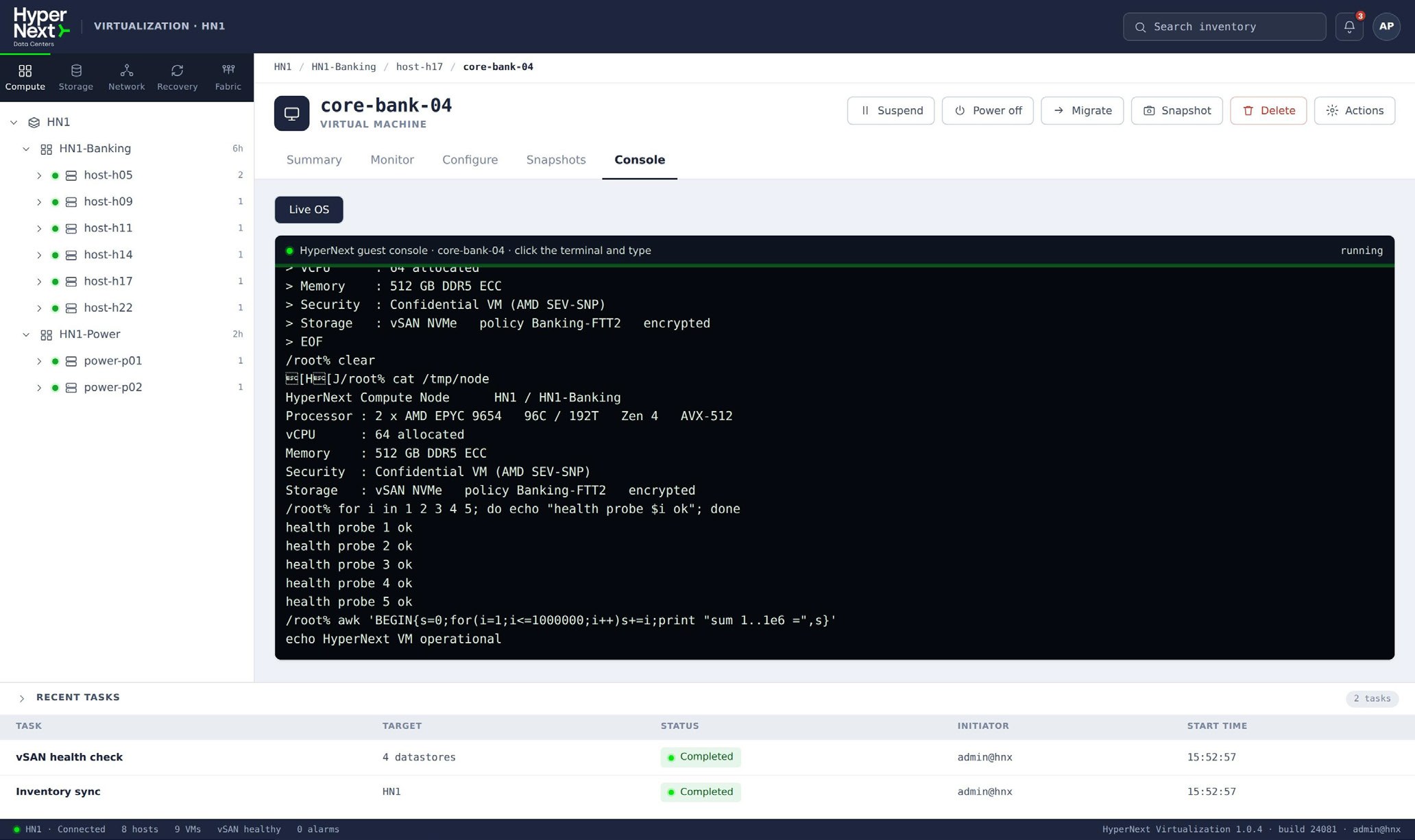
The virtualisation platform under Hyper 7 Cloud. A hardened KVM and QEMU base with a control plane HyperNext wrote, our own distributed storage, an operator console, a tenant console and a VDI module, with HyperNext’s security layer built in and watched by our own SOC.
A virtualisation layer that does not hold your workload in escrow.
Proprietary virtualisation charges by the socket, changes its terms by the year, and keeps the control plane somewhere you cannot audit. For a sovereign cloud in a regulated market, none of those is acceptable. So we wrote our own.
What changes
- Licensing
- No per-socket fee. The platform does not get more expensive because your hardware got denser
- Control
- The control plane is HyperNext code, running in India, auditable by the people who regulate you
- Lock-in
- Live migration, standard formats and open APIs, so a workload leaves as easily as it arrives
- Evidence
- Built from the start to the audit standard for MeitY cloud empanelment and ISO 27001, with the compliance mapping in the design documents
A proven base. A new brain.
The hypervisor is KVM and QEMU, the most widely run and most closely inspected virtualisation code there is. Everything that decides where a workload goes, how it is protected and what it may touch is ours.
Modules
- Hypervisor
- Hardened KVM and QEMU, performance tuned
- Control plane
- HyperNext-owned, written in Go. Placement, migration, tenancy, policy and API
- Storage
- VNext Distributed Storage, written in Rust, in the 1.0 scope. Ceph retained only as a fallback backend
- Networking
- Integrated SDN with EVPN and VXLAN, per-tenant isolation
- Accelerators
- vGPU partitioning and NUMA-aware placement for dense compute
- VDI
- A separate module for virtual desktops, on the same platform and the same consoles
- Operator console
- Fleet, tenants, capacity, incidents and evidence, screen by screen
- Tenant console
- Self-service compute, storage, network and backup, with the bill built from the same telemetry you see
Our own storage engine.
VNext Distributed Storage is not a roadmap item. It ships in 1.0, written in Rust for memory safety at the layer where a fault costs the most, with Ceph kept only as a fallback backend during the transition.
Two consoles. Every button specified.
The operator console and the tenant console were specified screen by screen before a line of them was written: every field, tab, message and owner. It is the only way a console comes out consistent.
VNext operator console
Watched by our own SOC.
VNext carries HyperNext’s security layer at system level, not as an add-on, and the platform is watched by the HyperNext security operations centre alongside the campuses it runs in.
Built in
- System-level security
- HyperNext’s own security layer in the platform, not bolted on above it
- Sovereign operation
- Controllers, logs and keys in India. No support access from outside India
- Audit standard
- Designed to the MeitY cloud empanelment audit and ISO 27001, with the compliance mapping maintained in the design set
- Monitoring
- Watched by the HyperNext SOC, the same one that watches the campuses
The hypervisor under IBM Sovereign Core.
IBM Sovereign Core on x86 integrates with VNext through its APIs and runs on VNext as the hypervisor layer beneath it. One sovereign stack, from the silicon to the service.
Also offered as a service
Talk to the engineering team.
Specifications, drawings and deployment planning for the 800 VDC product line. Designed by HyperNext Engineering, Toronto. Made in India.