HN-RP-010
03 July 2026
Engineering
Autonomous DDoS Scrubbing at Line Rate
Dual-algorithm filtering, sub-60-second autonomous mitigation, edge absorption, and packet-level enforcement for the AI-native data centre
The economics of distributed denial-of-service have inverted. Public threat reporting through 2025 records a near-continuous escalation of peak attack volume, from 6.5 Tbps early in the year to 31.4 Tbps in November 2025, the largest yet measured, sustained for roughly 35 seconds. At the same time, 99 per cent of attacks remain under 1 Gbps and most last under a minute. The defensive consequence is unambiguous: an attack now begins and ends faster than a human operator can read the first alert, so mitigation must be autonomous. This paper describes HyperNext Scrub, a sovereign scrubbing service built on a dual-algorithm filter, an autonomous mitigation pipeline that detects, classifies, diverts, scrubs, and returns clean traffic in under 60 seconds, an absorption model that owns the everyday band and rents the rare multi-terabit tail, and a line-rate enforcement datapath. Every packet is inspected inside India. It closes with the threat that motivated it: frontier AI capable of discovering and weaponising novel attack vectors autonomously, and the defensive posture that answers it...
HN-RP-009
04 June 2026
Policy
Frontier AI and the Indian Banking System
Cybersecurity risks from Mythos-class AI and a framework of safeguards for the financial sector
On 8 April 2026, Anthropic PBC released Claude Mythos Preview. In published evaluation across 198 manually-reviewed vulnerability findings, the model agreed with expert human severity assessment in 89 per cent of cases. Across ten fully-patched targets in internal Anthropic testing, the model achieved complete control-flow hijack. The implications for Indian banking are direct: UPI processed 21 billion transactions worth INR 27 lakh crore in December 2025 alone, the system depends on shared technology service providers serving up to 300 cooperative banks each, and the prevailing...
HN-RP-008
27 May 2026
Sustainability
The Water Math
Putting data center water use in context for India
The public conversation about data center water consumption in India has drifted some distance from the published numbers. Hyperscale data centers are routinely described as outsized consumers of water, with comparisons drawn that lack scale calibration. This paper compiles the actual numbers. A 64 MW HyperNext campus with closed-glycol direct-to-chip cooling and dry-cooler heat rejection consumes approximately 70,000 cubic metres of direct on-site water annually (530,000 cubic metres including embedded water in electricity), comparable to a 200-room luxury hotel, less than half what a...
HN-RP-007
13 May 2026
Market analysis
The India AI Compute Gap
Capacity, sovereignty, and the decade ahead
This paper examines the gap between India installed AI compute capacity in 2026 and the capacity the country will need by 2030 on the projected adoption curve. The numbers suggest a gap of between 6 and 23 gigawatts of equivalent capacity that has to be financed, built, powered, and operated within the four-year horizon. The paper works through the demand side honestly (enterprise inference, sovereign government workloads, BFSI, the consumer AI surface that an Indian...
HN-RP-006
29 April 2026
Engineering
Liquid Cooling at 600 kW per Rack
Direct-to-chip engineering for the rack-scale GPU era
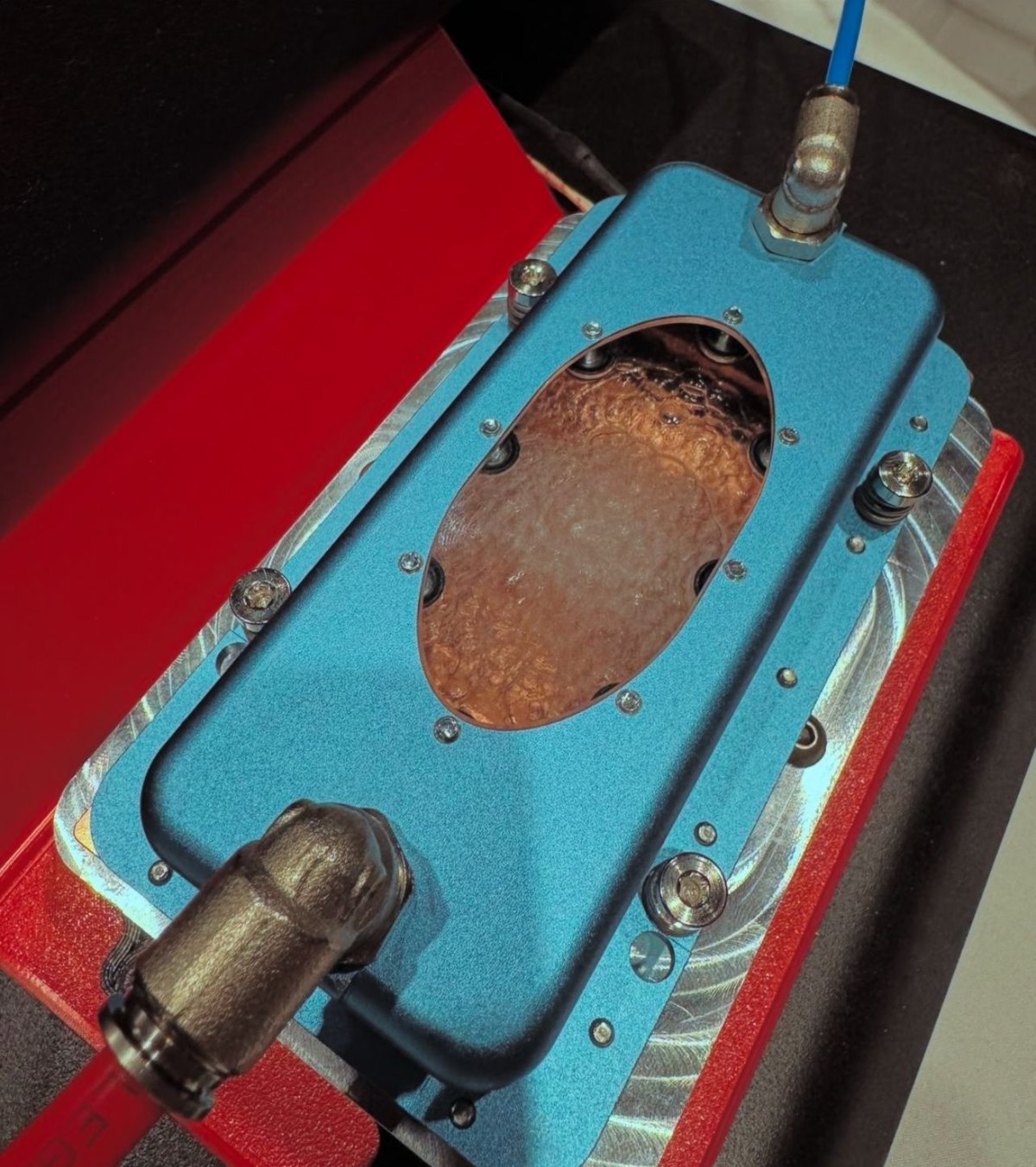
Air cooling stops working as a primary thermal medium somewhere around 50 kilowatts per rack. From that crossover up to the 600 kilowatts that the Vera Rubin Ultra NVL576 will draw, every kilowatt has to be moved by liquid. This paper covers the mechanics of doing that at production scale. We work through the cold plate design, the rack-level coolant distribution, the row-level coolant distribution unit (CDU), the secondary chilled-water loop, and the heat exchanger that hands the heat off to the building cooling plant. We use propylene glycol coolant in the primary loop, not water. We...
HN-RP-005
15 April 2026
Industry
From Training to Inference
How token economics are reshaping data center design
Training built the models. Inference will serve them. The two workloads are superficially similar. Both run on the same GPU hardware. Both demand high-bandwidth memory and fast interconnect. Both scale to thousands of GPUs in production. They are very different things to design infrastructure around. This paper examines what changes when token throughput becomes the unit by which AI infrastructure is measured. Cost per token. Power per token. Latency per token. We walk through the cost economics across legacy GPU generations and current Vera Rubin and AMD Helios systems and sketch what the...
HN-RP-004
20 February 2026
Engineering
HyperNext BMS
Supervisory control for Tier IV AI infrastructure
The traditional Building Management System was designed for environments where the workloads it served were unaware of the building infrastructure and largely indifferent to it. AI workloads have changed that. A rack-scale GPU system creates thermal and power dynamics that need sub-second visibility, predictive intervention, and supervisory control reaching across subsystems that used to run independently. This paper describes the HyperNext BMS, the supervisory platform that operates the Phase 1 Hyderabad campus and will scale to the 1.2 GW Kakinada AI Factory. It covers the operating...
HN-RP-003
12 December 2025
Industry
India's Sovereign AI Cloud
A framework for data residency that survives audit
"Data residency" and "sovereign cloud" have become loose terms in Indian cloud procurement conversations. The looseness now matters. The Digital Personal Data Protection Act of 2023, the RBI data localisation directives for payment systems, the MeitY guidelines for non-personal data, and the IT Act recent amendments together create a regulatory environment in which the specific layer at which sovereignty applies determines whether a given deployment is compliant or not. This paper proposes a three-layer framework to make the conversation more precise. Where the data physically sits is one...
HN-RP-002
15 September 2025
Engineering
800VDC: Power Architecture for the AI Rack Era
Why every 415 VAC distribution path is now a stranded asset
Design power per rack in hyperscale AI data centers will move from around 22 kW in 2018 to 600 kW by 2027. That is not an incremental change to the existing power architecture. It is a break. This paper walks the energy budget from the high-voltage utility feed to the GPU package, accounts for every conversion loss along the path, and compares the conventional six-stage 415 VAC architecture with the four-stage 800 VDC architecture HyperNext is building. The end-to-end efficiency gap is roughly twenty percentage points. Conventional delivers 75 percent of grid energy to the chip. 800 VDC...
HN-RP-001
05 June 2025
Sustainability
The Nagmati Programme
A water-positive framework for data centers in India
A gigawatt-class AI campus moves through four to fifteen billion litres of water a year. The number depends on the cooling architecture and on how honest the accounting is. PUE has been the industry default metric for twenty years. It says nothing about that water. It also stays silent on the water embedded in the electricity the facility buys. This paper proposes a more honest accounting. It separates three layers of water responsibility: on-site use, water embedded in electricity, and watershed-scale impact in the geography of operation. It also introduces the Nagmati Programme, which is...