Engineered for the
AI decade.
HyperNext is India's first data center built around 800VDC power architecture and rack-scale AI systems from NVIDIA and AMD, designed for the workloads of 2028, not 2018.
Why 800VDC is the future
of AI data centers.
AC distribution served the data center for forty years. For the densities AI now asks of us, it stopped being enough. We made the shift. Eight hundred volts of direct current, end to end, because it is the only honest answer at this scale. Pushed forward by the Open Compute Project and adopted by NVIDIA, AMD, Google, Microsoft and Meta, 800VDC is the architecture the hyperscale industry is converging on.
Every conversion costs energy.
The fewer the conversions, the more tokens per watt.
The same megawatt produces more tokens. That is the entire point.
Built for AI density
Modern AI racks draw 100 kW and beyond. 800VDC delivers that power natively, no Frankenstein retrofits, no compromise on stability.
Fewer conversions, more efficiency
Traditional architectures convert power up to six times before it reaches a chip. 800VDC eliminates most of those stages, directly improving facility PUE.
Less copper, lighter cabling
Higher voltage means lower current for the same power. Cable sections shrink dramatically, freeing pathways and reducing material cost across the facility.
Aligned to the OCP standard
800VDC is the architecture NVIDIA, AMD, Google, Microsoft and Meta have been pushing through the Open Compute Project. We're building to the standard the industry is converging on.
Future-proof headroom
The next generation of AI accelerators is being designed for DC power delivery. A facility built for 800VDC today is one that can host the racks shipping in 2028, without re-platforming.
Cleaner power quality
Direct current eliminates the harmonic distortion and reactive losses inherent to AC distribution at scale, translating to cleaner, more predictable power at every rack.
Same megawatt in.
More compute out.
Two differences. What a rack is allowed to draw, and what it costs to run once it does.
India's first Vera Rubin
rack-scale system.
It is filling the Hyderabad campus now, on the same 800 VDC power and direct-to-chip cooling we built for exactly this load, with NVLink fabric across the pod, the CUDA stack above it, and Vera Rubin Ultra NVL576 waiting at the Kakinada AI Factory on day one.
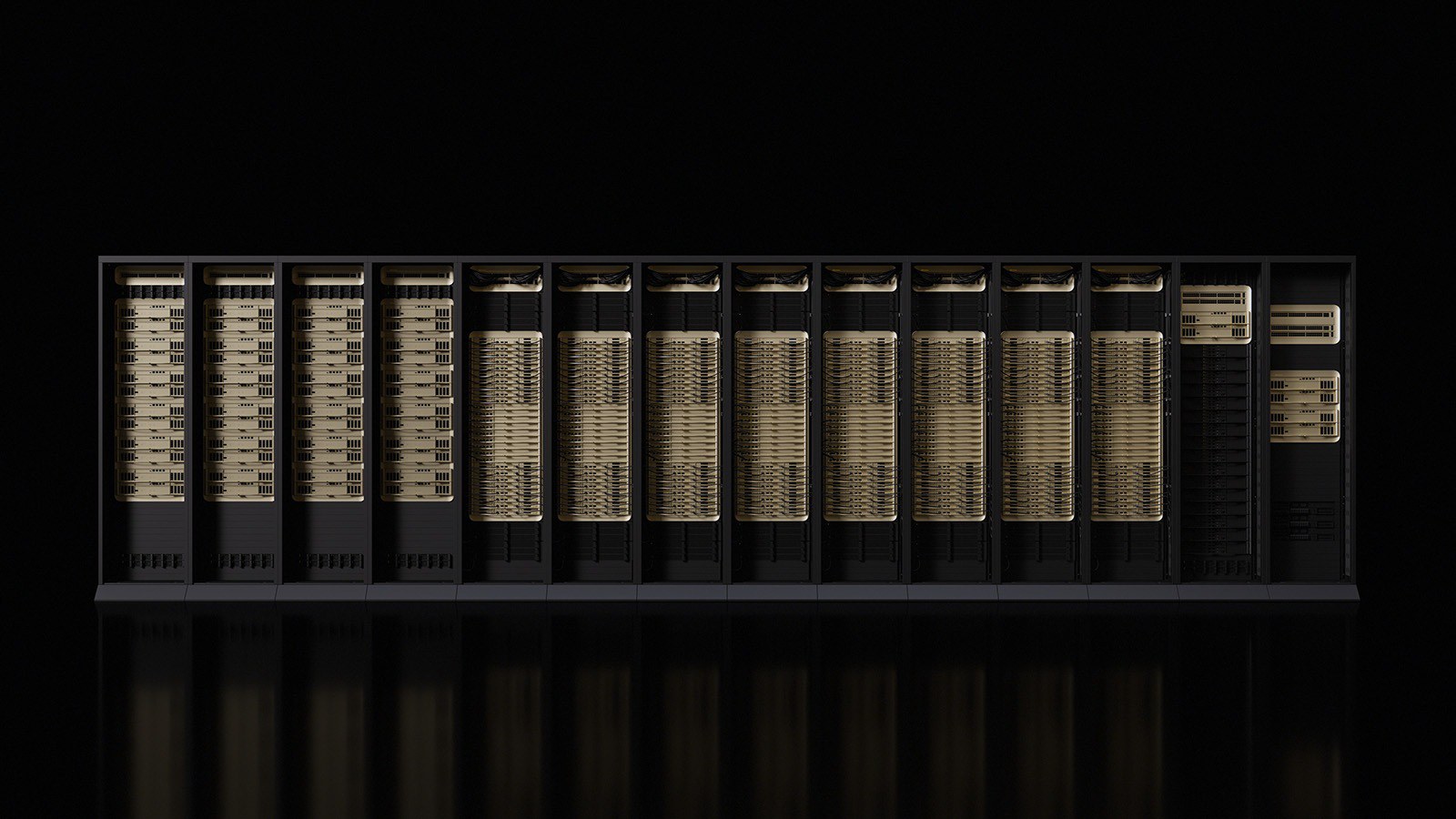
8 × 2 pods · 240 kW per rack · 800 MW AI cluster deploying
Built for every shape
of AI compute.
A workload should not have to compromise to fit infrastructure. Infrastructure should adapt. From inference at the edge of a transaction to simulations that run for months, the stack we built bends to the work.
Inferencing
High-throughput, low-latency inference for production AI, chatbots, recommendation, fraud detection, vision pipelines and agentic workloads.
RAG Systems
Retrieval-augmented generation that anchors LLMs in your own knowledge base, built on infrastructure tuned for vector throughput and dense storage.
Physical AI
Simulation, robotics, autonomous systems, workloads that bridge digital intelligence and the physical world.
Scientific AI
Drug discovery, climate modelling, computational fluid dynamics, long-running HPC workloads that demand sustained performance.
Open by design.
Vera Rubin and AMD Helios, side by side. Genuine choice, not the appearance of it. For inference, for retrieval, for physical AI, for scientific work. Our partnership with AMD brings the Helios rack-scale system to India for the first time, an open platform that has the potential to reshape India's AI infrastructure economics.
Power & Mainframe
as a Service.
For Indian banks, IBM Power and IBM Mainframe arrive directly. As managed services. From us. The intermediaries that historically sat between Indian banks and the platforms they ran on, do not sit here. Lower cost, faster onboarding, accountable SLAs.
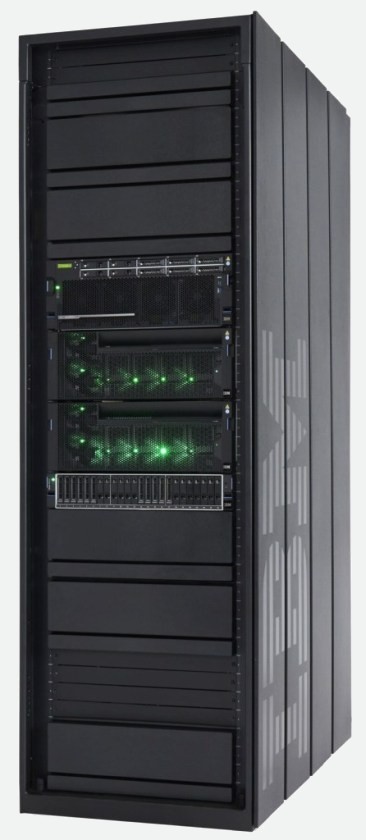
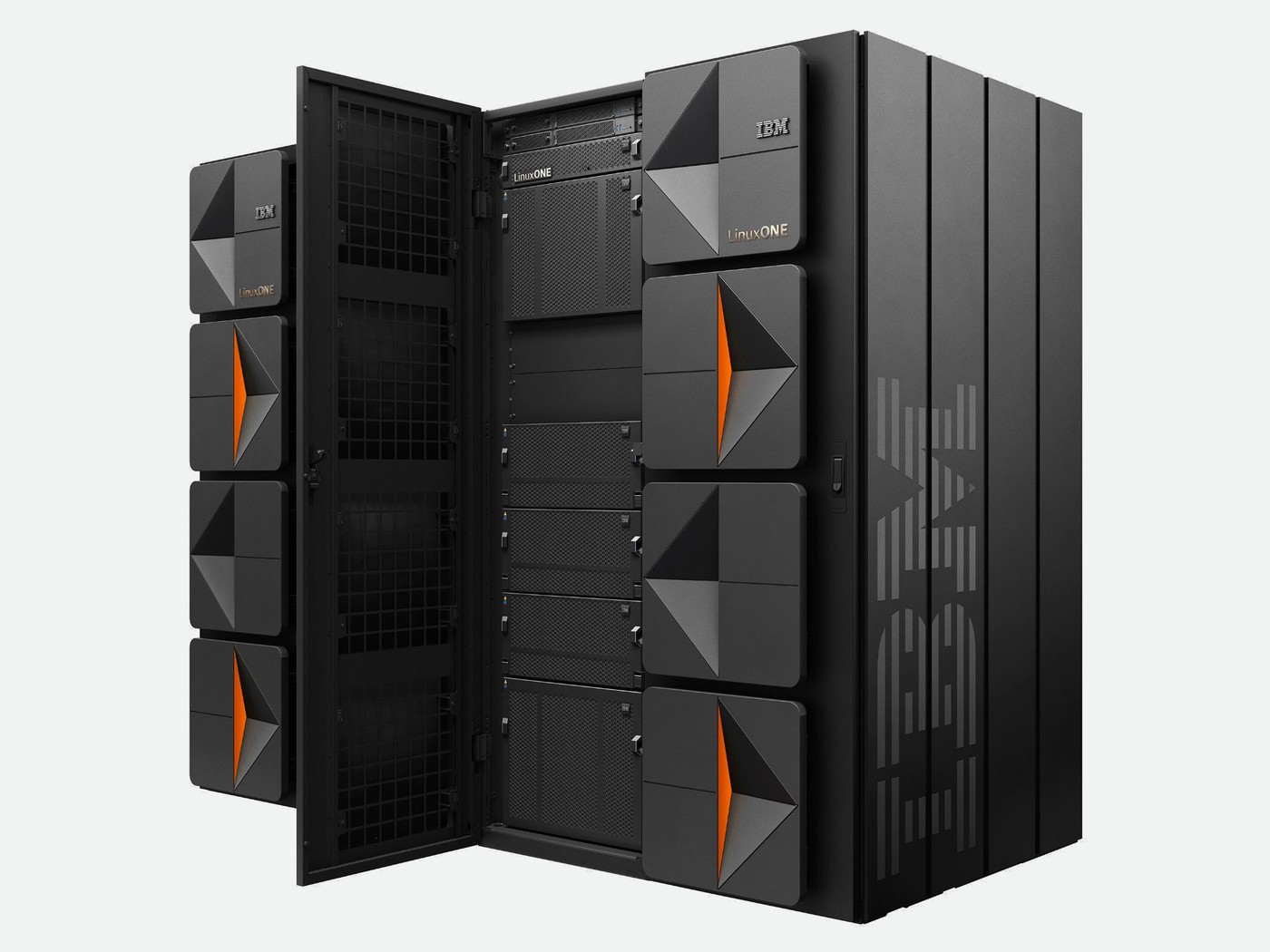
IBM Power11 · IBM Z
Sizing for an AI workload?
Tell us about your model, your latency target, and your ramp plan, we'll size, price and schedule a deployment.
Run your CUDA models
on our AMD systems.
At NO transfer cost.
You should not be held hostage by the choice you made two years ago. We don't think that is right. So we built a path. CUDA to ROCm, translated, tuned, and validated by us. Your model still runs. Your numbers still hold. The silicon underneath happens to be AMD Helios. We pass NO engineering cost on to you, because the engineering cost should never have been yours to begin with.
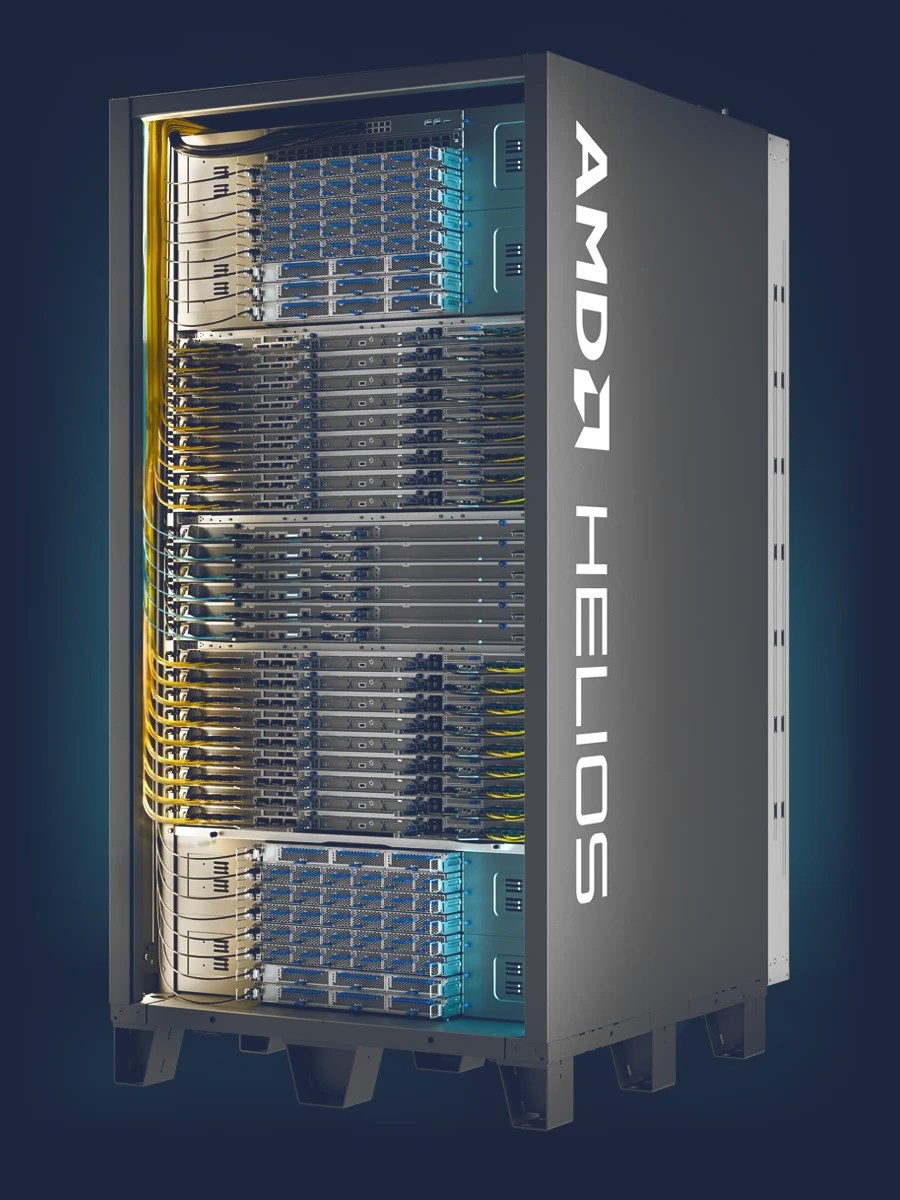
AMD Helios · rack-scale
Twenty-two workloads.
No two alike.
Some workloads ask for scale. Others ask for stillness. Some need every watt of every accelerator. Others need a careful answer in twelve milliseconds. Twenty-two workload patterns, each with its own discipline. We considered each one. We did not retrofit anything.
Frontier model training
Multi-thousand GPU clusters with NVIDIA Vera Rubin Ultra NVL576 and AMD Helios. Rack-scale liquid cooling. Lossless InfiniBand and 800G Ethernet fabric. Continuous training at >90% MFU.
Agentic AI & inference
Production-grade inference with sub-millisecond latency for agentic workflows. Multi-tenant isolation. KV-cache optimisation, speculative decoding, and dynamic batching tuned for tool-use latency budgets.
Healthcare & diagnostics
Non-invasive diagnostic AI for early disease detection. Genomic and proteomic inference. Federated medical models with patient data never leaving the sovereign boundary.
Drug discovery
Molecular simulation, protein folding, and hybrid AI-physics models for pharmaceutical R&D. HPC-class precision combined with AI-class scale. IP protected inside India.
Financial services AI
Real-time fraud detection, credit decisioning, algorithmic trading and risk analytics. RBI-compliant deployment with sub-millisecond inference latency for transaction streams.
Physical & embodied AI
Robotics training, simulation, and digital-twin workloads for manufacturing, defence and autonomous systems. NVIDIA Omniverse and Isaac platform ready.
Scientific computing
Climate modelling, materials science, fluid dynamics and quantum chemistry. HPC-grade interconnect with AI-grade accelerators. Suitable for AIRAWAT and CSIR-grade research.
Enterprise RAG & copilots
Sovereign retrieval-augmented generation and enterprise copilot platforms. Customer data never leaves the boundary. Pre-built integrations with leading vector databases and LLM frameworks.
Federated learning
Train across distributed customer enclaves without raw data leaving each enclave. Differential privacy guarantees, secure aggregation, and audit-grade lineage of every gradient update.
Multimodal & generative AI
Vision-language models, video generation, speech and audio synthesis. Fine-tuning on customer multimodal corpora with content-safety guardrails enforced inside the platform.
Telco AI & RAN
O-RAN intelligent controller workloads, network optimisation, beam-forming and self-organising networks. DoT-licensable and edge-deployable to telecom POPs.
Industry 4.0 & manufacturing
Computer-vision quality inspection, predictive maintenance, digital twin of factories, supply-chain optimisation. OT-IT bridge with field-bus integration.
Quantum-classical hybrid
Hybrid quantum-classical workflow execution. Variational quantum eigensolvers, QAOA optimisers, and classical co-processing for emerging quantum computing partners.
Government & sovereign AI
Whole-of-government inference platforms, citizen-data analytics, national language models, and inter-departmental data fabric workloads. Sovereign-by-architecture.
Speech & language
Speech recognition, translation, and natural language understanding at scale. Indic-language model training and inference, multilingual dialog systems, conversational AI for service workloads.
Computer vision at scale
Image and video understanding, manufacturing inspection, surveillance analytics, retail computer vision, and medical imaging classifiers. Pipelines that operate continuously, not in batches.
Recommendation systems
Two-tower retrieval, deep ranking, and personalisation engines running at internet scale. Latency-bound serving with continuous incremental training and tight feature-store integration.
Cybersecurity AI
Threat detection, behavioural anomaly models, malware classification, and security copilots. Real-time inference against streaming telemetry from SOC and NOC pipelines.
Code generation
Developer copilots, code review automation, repository-wide understanding, and SRE assistants. Fine-tuning on customer codebases inside the sovereign boundary.
Time series & forecasting
Energy load forecasting, demand prediction, capacity planning, financial time series, and weather-coupled industrial optimisation. Continuous training on rolling windows.
Reinforcement learning
Policy training for control systems, robotics, energy management, and operations research. Long-horizon simulation environments coupled with GPU-accelerated rollouts.
Synthetic data & simulation
Synthetic data generation for training where real data is scarce or restricted. Domain-specific simulation environments for autonomous systems, industrial AI, and clinical research.
29 patents granted.
14 under approval.
Engineering is something we take seriously. The patents speak more carefully than we could.
Cancer detection AI
Non-invasive early detection models, multi-modal imaging analysis, and tissue-classification networks.
Clear aligner manufacturing
AI-driven orthodontic planning, treatment-path prediction, and aligner manufacturing optimisation.
Antimicrobial resistance
Resistance-pattern prediction, treatment-recommendation models, and pathogen-genome AI.
Hybrid molecular drug discovery
Physics-informed neural networks for protein-ligand binding and lead-compound optimisation.
Multi-threading for AI on CPU
Cache-aware threading and instruction-level scheduling for efficient AI inference on CPU-only hardware.
Memory load balancing
Dynamic memory allocation and NUMA-aware scheduling for optimum utilisation under heavy AI workloads.
Software that saves you
millions in licensing.
We built our own. We have reasons. An operating system that does not extract a tax with every socket. A virtualisation layer that does not hold your workload in escrow. A building management system that does not depend on a single vendor remembering you in five years.
HyperONE OS
A hardened, performance-tuned operating system replacing expensive proprietary alternatives without losing a single capability.
- RHEL-compatible binary interface
- Real-time scheduling for AI workloads
- FIPS 140-3 cryptographic modules
- Zero per-socket licensing fees
- Integrated container and KVM runtime
- Hardened by default, audit-ready
HyperONE Virtualisation
Enterprise-class virtualisation that meets every demand of regulated, high-density environments. No hostage taking.
- Live migration with zero packet loss
- vGPU partitioning for NVIDIA & AMD
- NUMA-aware VM placement
- VMware-compatible APIs
- Integrated SDN with EVPN/VXLAN
- Per-tenant resource isolation guarantees
In-house BMS
A vendor-agnostic Building Management System developed independently in-house. Real-time facility telemetry without lock-in to any single OEM, down to the coolant chemistry in the dry-cooler loops, sensed live by our inline fluid-quality valve.
- BACnet, Modbus, SNMP, OPC-UA native
- Real-time facility monitoring
- Integrated with Digital Twin platform
- Predictive maintenance ML models
- Cross-vendor alarm aggregation
- Open API for customer integration
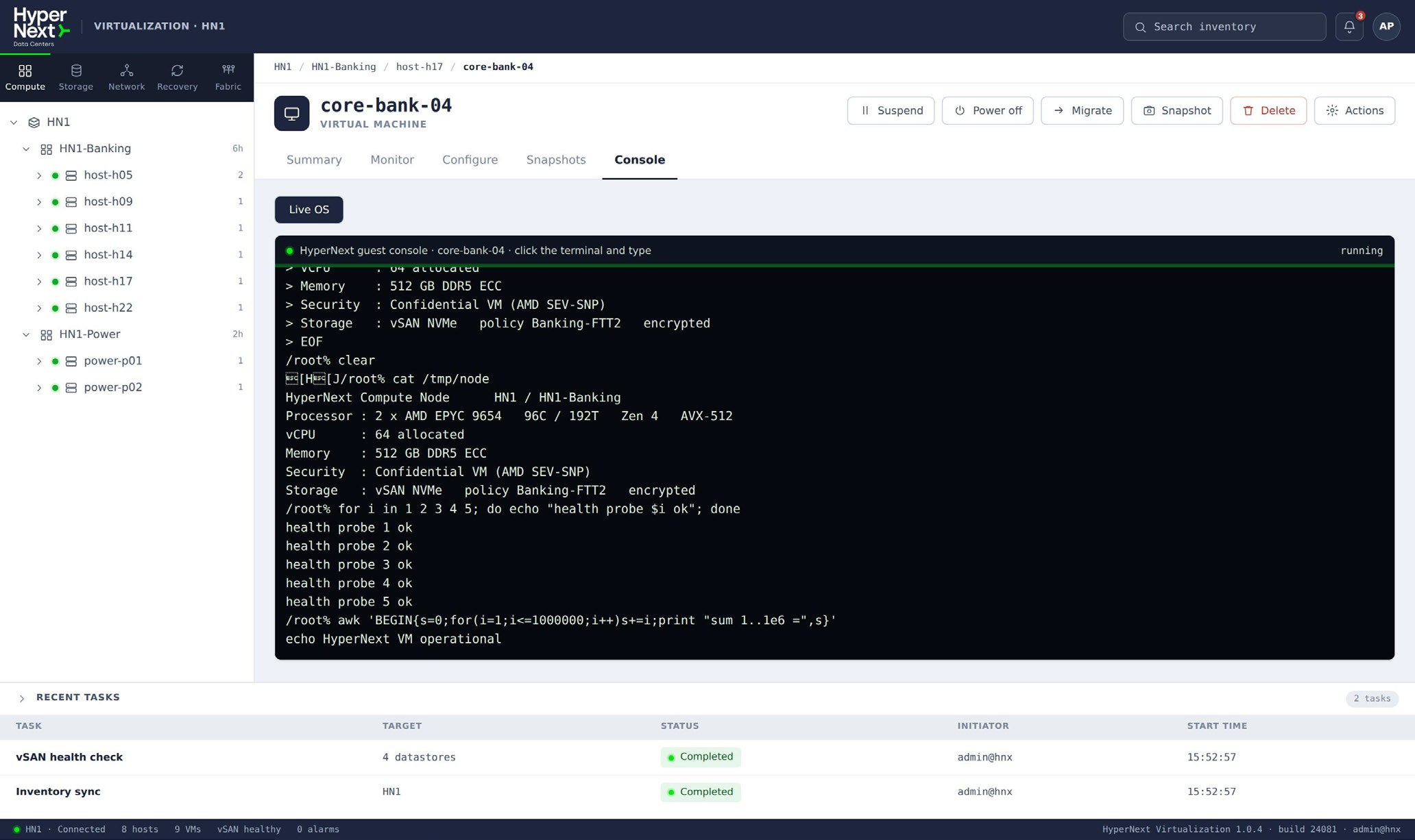
One control plane. x86 and IBM Power in a single inventory, with a real guest shell and no agent to install.
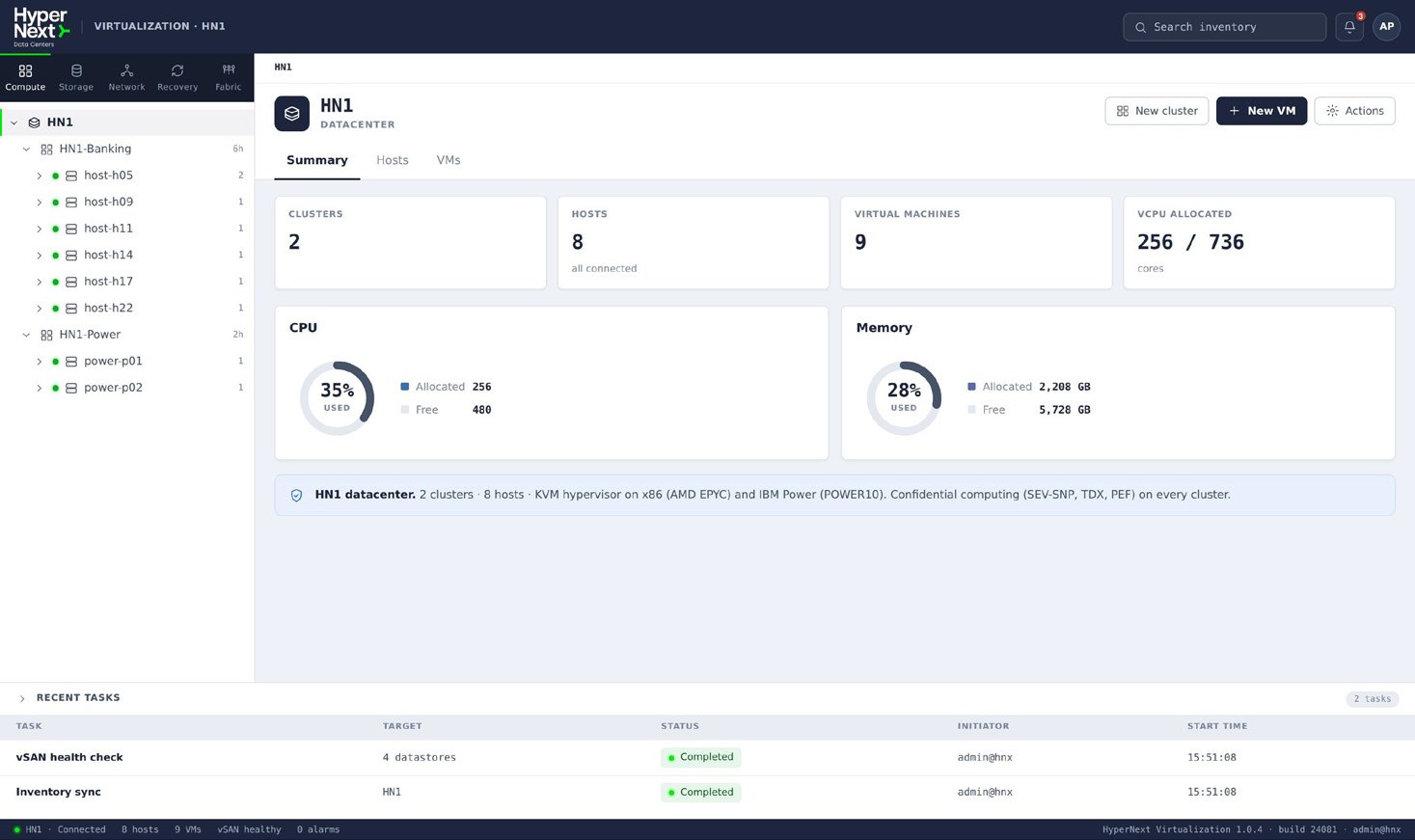
A real guest shell in the browser. No client, no plugin, no agent.
Best-in-class PUE,
even at 45°C.
India's ambient temperatures peak at 40 to 45 degrees Celsius for months at a time. Conventional data center electrical designs degrade significantly above 35°C. Our patented electrical architecture maintains best-in-class PUE through the hottest peak hours, every day of the year.
Single compartmentalised system.
Hyperscale reliability.
There are systems that fail well, and systems that fail badly. We chose to build one that fails well. Compartmentalised by design. Concurrently redundant. Tier IV at every campus, by the Uptime Institute. Not the rating. The thing itself.
True compartmentalisation
Physical and electrical isolation between power and cooling trains. A single fault cannot propagate beyond its compartment. Concurrent maintenance across the entire facility with zero workload impact.
Tier IV across every site
All HyperNext campuses are Uptime Institute Tier IV. Not Tier III. Not "Tier IV-ready". Tier IV certified by the Institute, with constructed-facility certification scheduled at commissioning. No exceptions.
Concurrent redundancy
2N power, 2N cooling, multiple independent network paths, and physically diverse standby generation. Any component can fail or be taken offline for maintenance without affecting any workload.
Hyperscale-grade reliability
Designed and commissioned to the same operational standards as the top three global hyperscalers. Same fault domains, same redundancy assumptions, same continuous-availability principles.
365 days of security logs.
Free.
For three hundred and sixty-five days, we keep every security log. We don't charge extra. We don't hide it in a tier. We don't quietly rotate it at thirty days. A full year of forensic visibility, because we don't think you should have to ask.