
Scrub
Clean in under sixty seconds.
Autonomous DDoS mitigation at line rate. Detection to clean return in under sixty seconds, without a human in the loop, with every packet inspected inside India. Scrub protects the HyperNext campuses, Hyper 7 Cloud and Nwan Internet, and is available to tenants as a service.
Detect, divert, clean, return.
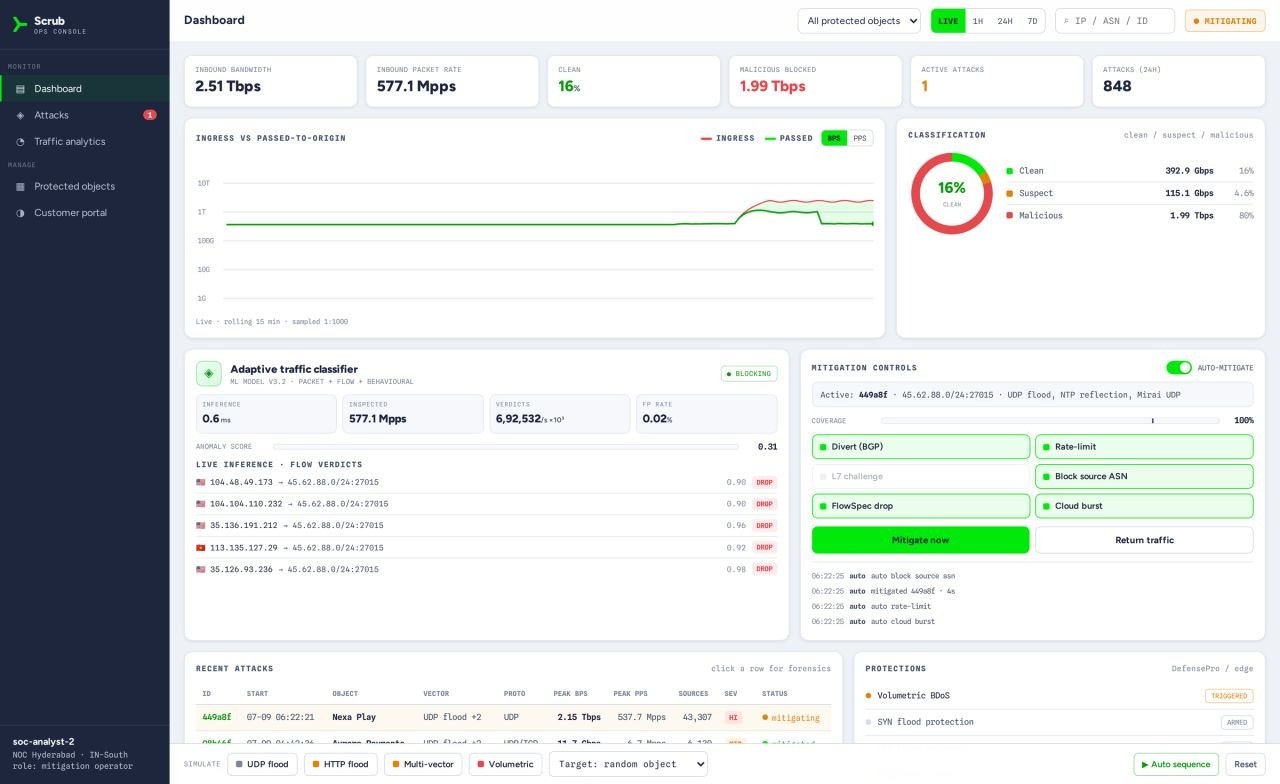
An attack is recognised from flow telemetry, the affected prefix is diverted into the scrubbing centre on campus, the attack traffic is dropped at line rate and the clean remainder is returned to the tenant. The whole loop closes in under a minute and no person has to be awake for it.
The loop
- Detect
- Flow telemetry from the edge, baselined per tenant and per prefix
- Divert
- The affected prefix is drawn into the scrubbing centre on the campus edge
- Clean
- Attack traffic dropped at line rate, clean traffic passed untouched
- Return
- Clean traffic handed back over the private path, and the diversion withdrawn when the attack ends
On campus, in front of everything.
Scrub runs on the HyperNext campuses themselves, so nothing is hauled abroad to be cleaned and nothing waits on a third party. It fronts Hyper 7 Cloud, cleans Nwan Internet transit, and is available to colocation tenants on their own prefixes.
Scrub console · live mitigation
Watched by our own people.
Mitigation is autonomous. Oversight is not. The HyperNext security operations centre sees every event, with the response commitments below.
SOC commitments
- Mean time to detect
- 15 minutes, critical incidents
- Mean time to respond
- 30 minutes, P1 incidents
- SOC platform availability
- 99.9 per cent
- Scope
- Hyper 7 Cloud, Nwan, VNext and the campus networks, from one centre
HN-RP-010: Autonomous DDoS Scrubbing at Line Rate.
The design is published in the HyperNext Research series. The paper sets out the detection model, the diversion mechanics and the measurements behind the sixty-second figure.
Also offered as a service
Talk to the engineering team.
Specifications, drawings and deployment planning for the 800 VDC product line. Designed by HyperNext Engineering, Toronto. Made in India.