
R600
One rack. Every workload.
Accelerated compute at 150 kW, IBM Power, general servers and storage, on one welded frame. Native 800 VDC, liquid when it is needed, built to Indian standards at the highest grade each one offers.
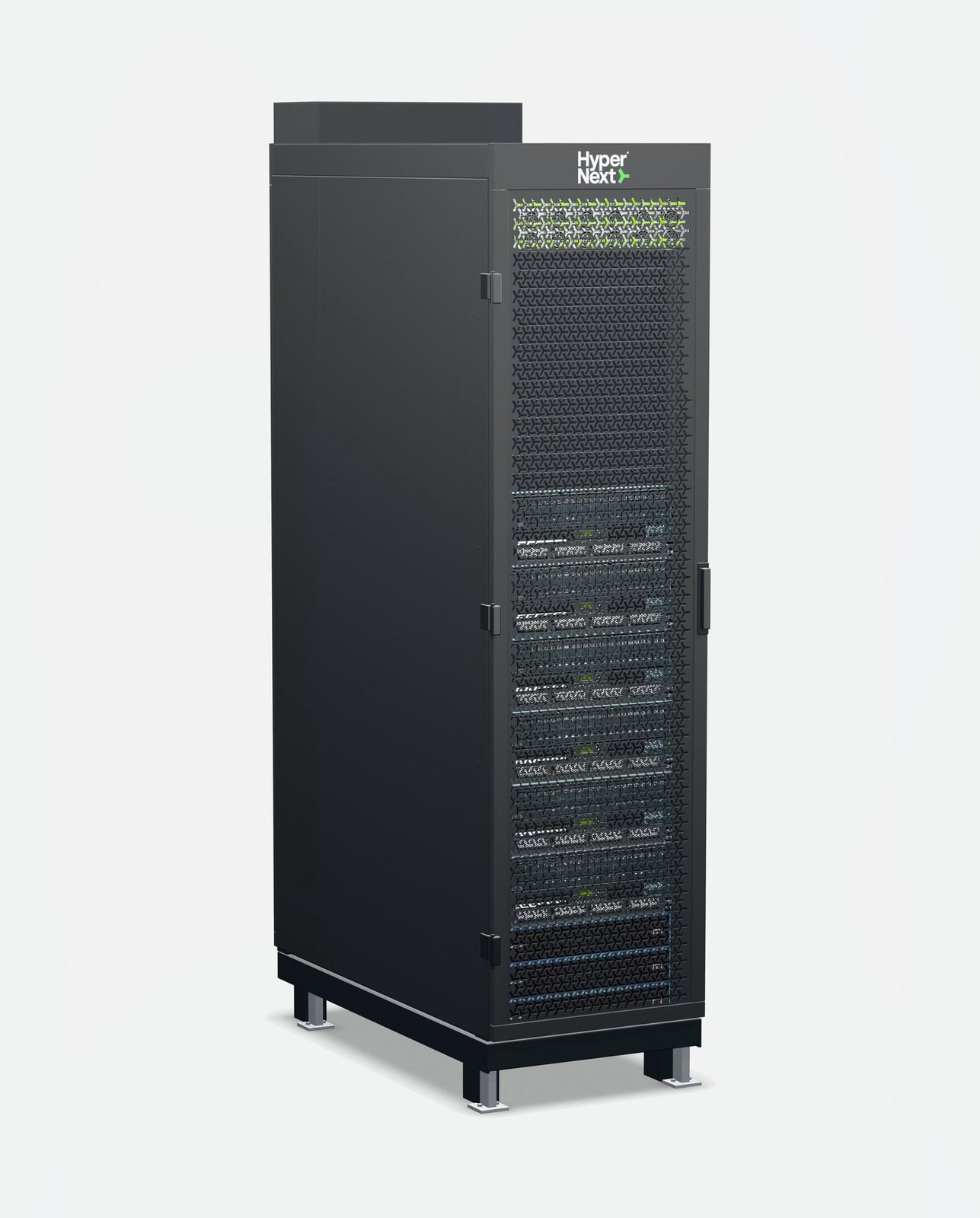
Four models. One frame.
A floor holds a mainframe-class rack drawing under seven kilowatts, a colocation cabinet at twelve to eighteen, and accelerated compute at a hundred and fifty, often in the same row. Buying three rack families for that works until the floor changes.
Four models
AI-150
R600-AI-150-L1
- Capacity
- 150 kW
- Serves
- Accelerated compute, liquid cooled
- Mounting
- Open Rack V3, 44 OU at 48 mm
- Power
- DC to DC shelves, 50 V busbar at 3,200 A
- Frame
- R600, 1,219 deep
IBM-50
R600-IBM-50-L0
- Capacity
- 50 kVA
- Serves
- IBM Power, per path
- Mounting
- EIA-310, 719 mm flange spacing
- Power
- DC to AC shelves, horizontal PDUs
- Frame
- R600, 1,219 deep
SV-25
R600-SV-25-L0
- Capacity
- 25 kVA
- Serves
- 19 inch servers and network, per path
- Mounting
- EIA-310, 43 RU
- Power
- DC to AC shelves, zero-unit PDUs
- Frame
- R600, 1,219 deep
ST-25
R600D-ST-25-L0
- Capacity
- 25 kVA
- Serves
- Deep storage, per path
- Mounting
- EIA-310, 699.5 mm clear behind the rear rail
- Power
- DC to AC shelves, zero-unit PDUs
- Frame
- R600D, 1,600 deep
Every model is the same welded frame with a different set of kits, bolted on at the factory or on site. A rack converts between models without cutting, welding or re-coating, so a hall can change what it does without changing what it is made of.
The code and the frame
- Model code
- Frame, workload, capacity, liquid level. L0 is air, L1 is direct liquid cooling, fitted at the factory or added later as a kit
- R600
- 600 × 1,219 × 2,350 mm. Bays at 600 mm pitch with no gaps
- R600D
- Adds 381 mm of depth for long storage enclosures
Same frame. Different kits.
Every kit fixes to the same welded frame through the same nuts and brackets. The structure carries 2,200 kg static on its levelling feet and rolls at 1,500 kg loaded, because the rack ships with its equipment already in it.
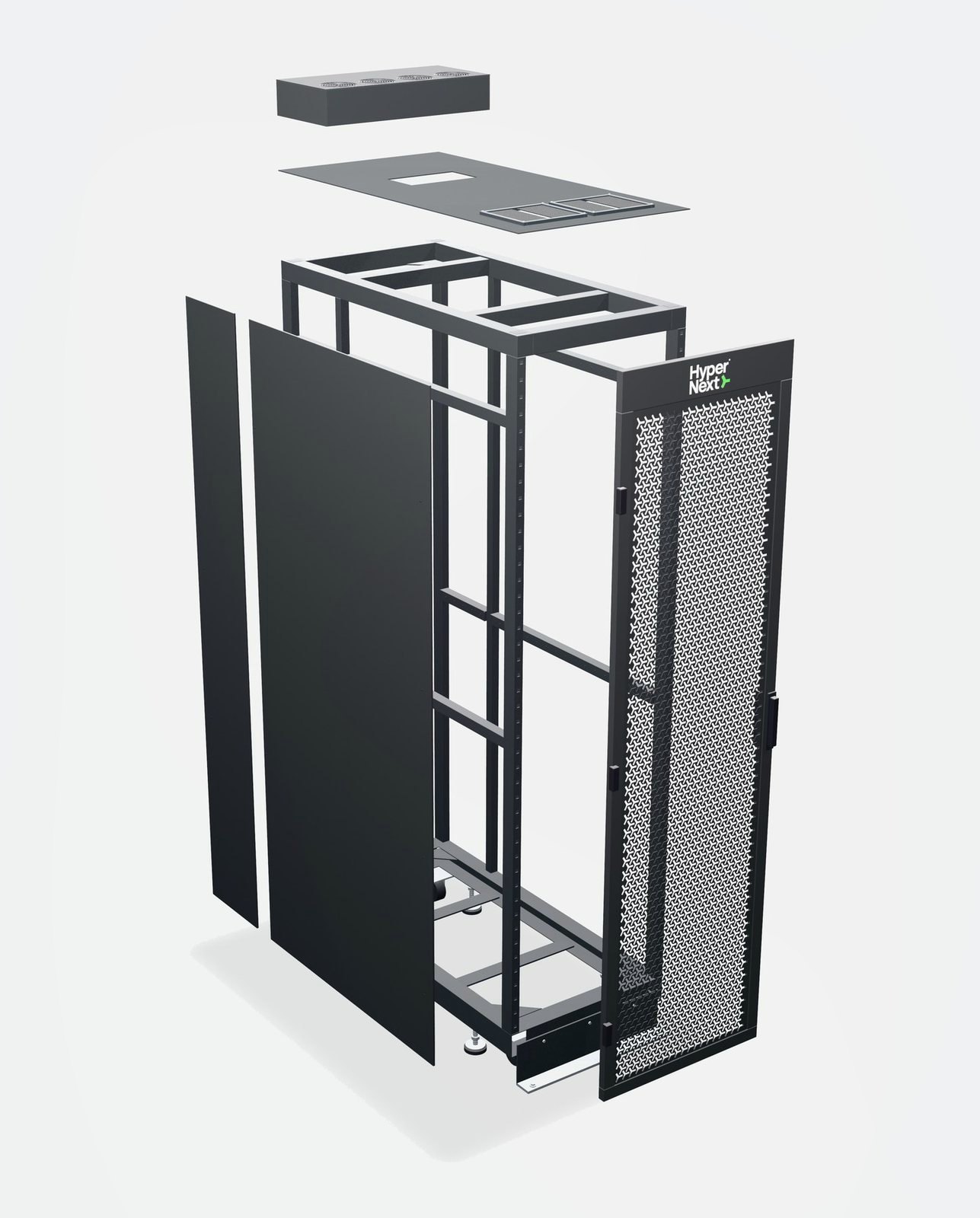
The rack as a kit of parts
Supporting two mounting standards in one frame is the part that costs something. Open Rack V3 works in 48 mm units across a 21 inch opening and EIA-310 works in 44.45 mm units across 19 inches. They are not compatible and no bracket makes them so, which is why the mounting is a kit: the frame carries the interfaces for both and one of them is fitted.
Converted at the top of the rack.
Equipment does not run at 800 volts. The trays want about fifty, and 150 kW at fifty volts is 3,200 amperes however the power got there. The high current is unavoidable. How far it travels is a design choice.
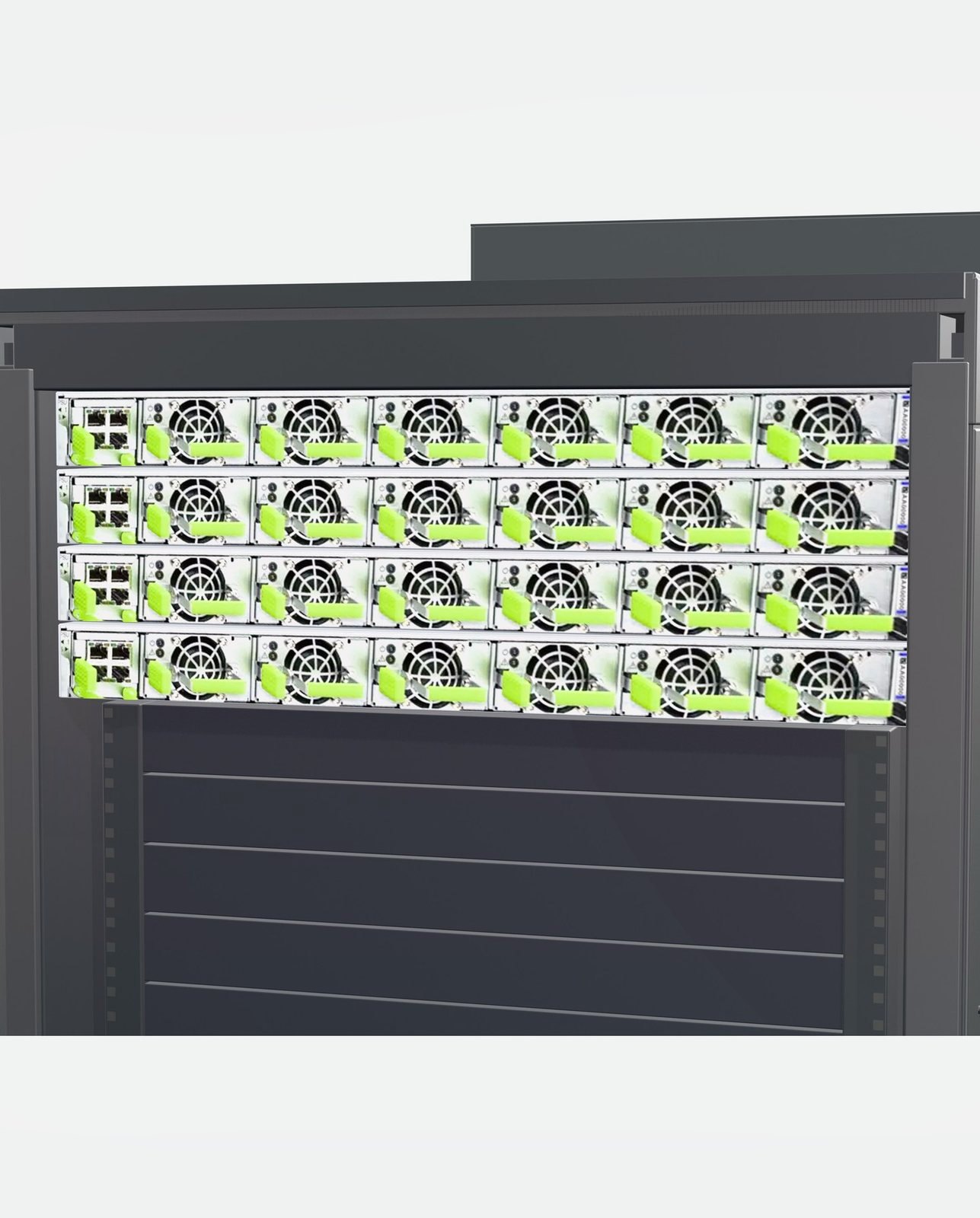
Conversion shelves at the roof, busbar down the back
Eight hundred volts arrives at the roof on two independent paths, is converted in the shelves, and leaves as a copper busbar down the back of the rack at 3,200 amperes. That busbar is a substantial piece of metal and it is 2.2 metres long. Had the conversion happened at the end of the row, the same current would have needed thirty metres of the same cross-section.
Because the shelves are modular and the busbar is sized for the full current from the start, adding capacity to a rack means adding a shelf. The rack is not rebuilt, the busbar is not replaced and the hall is not opened up.
Air today. Liquid when you need it.
Most racks delivered today are air cooled and most delivered in five years will not be. The frame accepts both, and moves from one to the other on site without being moved.
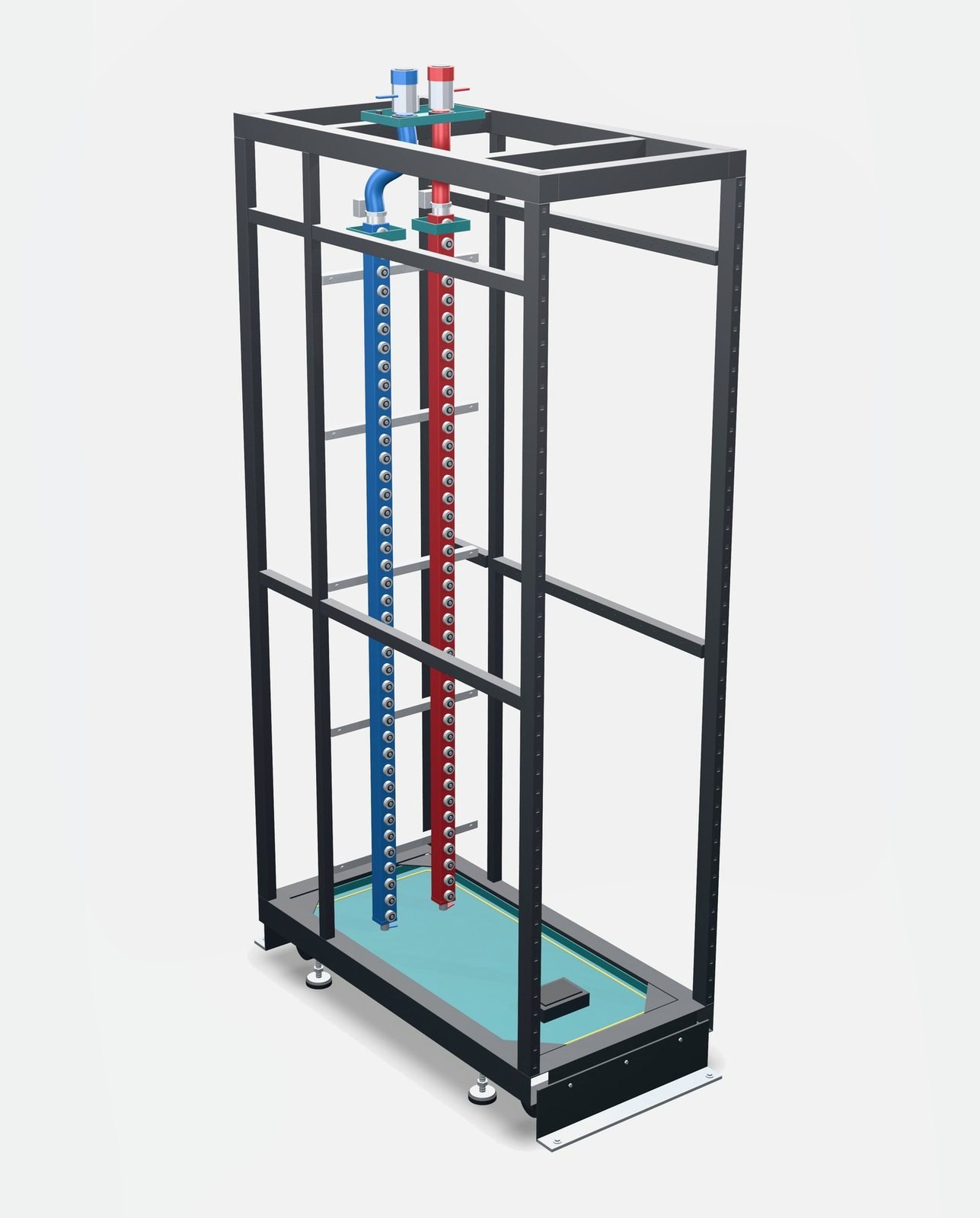
Liquid kit · manifolds, valves, trays and detection
Liquid kits
- MF40
- Full height. Two 316L stainless manifolds, DN50, 40 blind-mate ports across OU 1 to 40. 225 litres per minute at a 10 K rise
- MF20
- Mixed racks. 19 ports across OU 22 to 40, with the lower frame left on air
- Containment
- A drip tray under every liquid joint, a base drip tray on every rack, leak rope in every tray and pan
- Detection
- Alarm at 5 ml, reported by the rack controller
Every liquid joint sits over a drip tray, leak rope runs through every tray and pan to the rack controller, and the alarm threshold is five millilitres. That is a small volume deliberately: the point of detection is to find a weeping joint before it becomes a leak, not to confirm that a leak has happened.
The numbers.
R600 rack systems
- Frame
- Welded IS 2062 E350 C steel. 600 × 1,219 × 2,350 mm. R600D adds 381 mm of depth
- Load
- 2,200 kg static on M20 levelling feet. Rolls at 1,500 kg loaded on swivel castors
- Height
- 2,451.5 mm over the roof fan module. 2,540 mm over the liquid couplings
- Mounting
- Open Rack V3 at 44 OU, or EIA-310 at 43 RU. One kit fitted
- Power
- Up to six conversion shelves and a 3,200 A copper busbar on the AI model. Horizontal or zero-unit distribution on the alternating current models
- Cooling
- Roof fan module, four 120 mm EC units at three plus one, fed 2N from the 800 VDC input
- Doors
- 596 × 2,160 × 30 mm, prong perforation at 56.5 per cent open area, lift-off, 180 degrees, either hand
- Earthing
- Tinned copper frame bar to IS 3043. Every touchable part bonded, 0.1 Ω maximum, braided straps on doors and panels
- Seismic
- IS 1893 Part 1, Zone V, top floor. Four anchor brackets
- Finish
- Zinc phosphate and RAL 9005 fine texture powder coat, 80 µm minimum. Zinc flake fasteners rated to 480 hours of salt spray
- Shipping
- On a steel skid tied through the same anchor brackets, loaded, 2,541.5 mm packed, for a 40 ft high cube container
- Monitoring
- Rack controller reporting to the building system over RJ45
The rest of the line
Talk to the engineering team.
Specifications, drawings and deployment planning for the 800 VDC product line. Designed by HyperNext Engineering, Toronto. Made in India.