The Platform

We built the hard
parts ourselves.

The hardest parts were the ones nobody would sell us, so we built them ourselves. A sovereign cloud on IBM, our own DDoS mitigation, the fabric between our sites, and the building management system beneath all of it. We hold every drawing, which means we can answer for every decision. None of it is a roadmap of where this might go. It is running today.

Four systems

Four systems we run
our data centres on.

Each stands on its own. Each is built to combine. A common operating model, a common security posture, a common SLA framework, applied at every layer.

Hyper 7 · Sovereign Cloud

India's real
sovereign cloud.

Sovereignty is not one question. It is three: where the data sits, whose law governs access to it, and who holds operational control. Residency answers the first. Hyper 7 answers the other two, and then proves all three. The platform proves its own sovereignty, so you do not have to take our word for any of it.
Built on IBM
India's real sovereign cloud
Hyper 7 is built on the IBM Sovereign Cloud platform, with Red Hat OpenShift, Enterprise Linux, Red Hat AI and open APIs throughout, so your workload stays portable and can leave on your timeline.
One control plane
Compute, storage, network, recovery
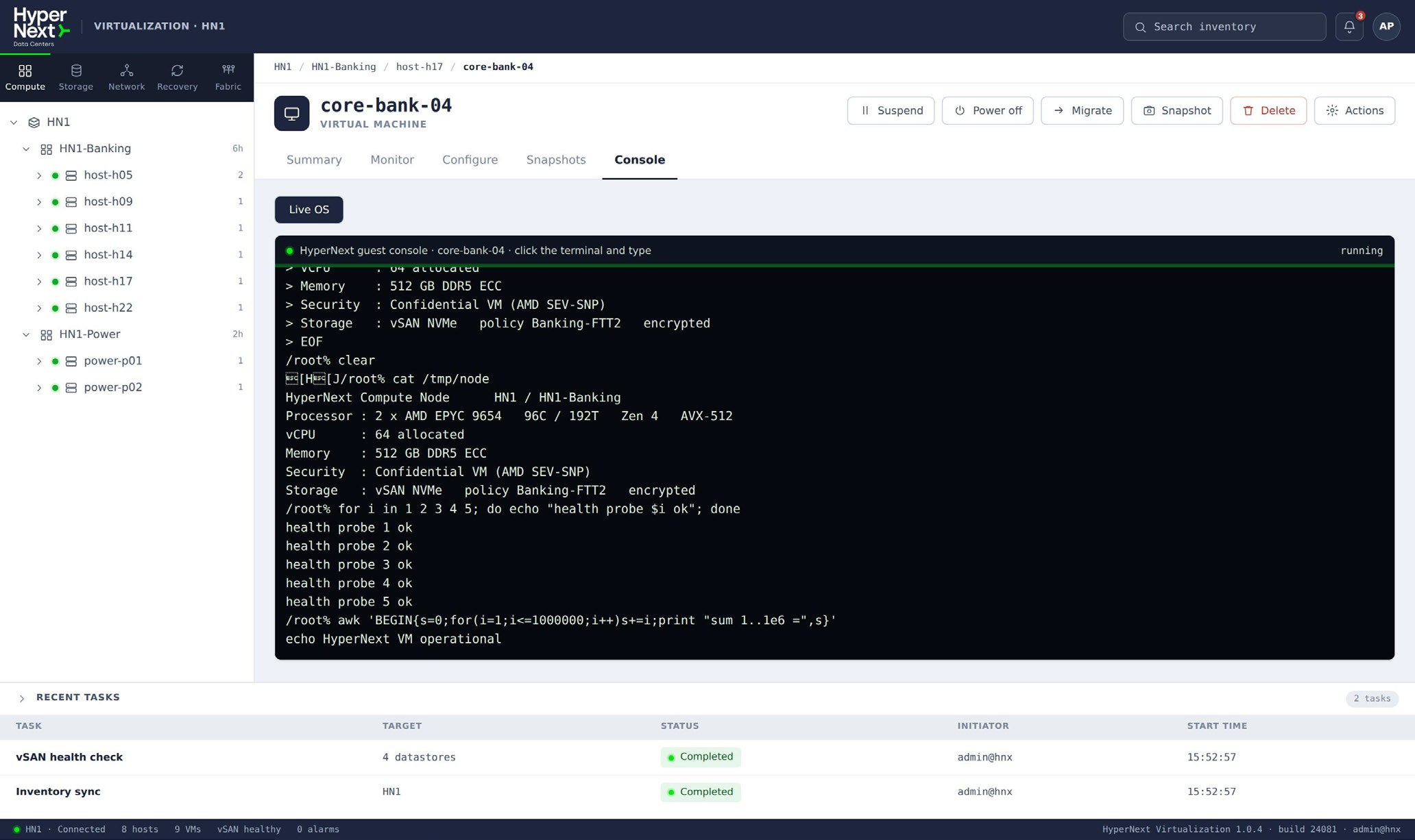
All of it in a single console, with AMD EPYC and IBM Power hosts held in one inventory under one policy model. A real guest shell in the browser, with no client, no plugin and no agent.
The Orchestration Layer
Every workload, one console
Choose IBM Power11 or HPE x86, pick the size, the operating system and the resiliency, and the layer places each workload on the best-fit frame, scored live against the campus. Included at no cost, and no obligation.
Confidential computing
Sealed even from the platform
AMD SEV-SNP memory encryption keeps tenant data sealed even from the platform, with per-tenant keys across a petabyte-scale vSAN and a firewall at every workload.
You hold the keys
FIPS 140-3 Level 4
Not HyperNext, not IBM, not the host nation. Keys anchored in FIPS 140-3 Level 4 hardware. You operate the control plane; identity, access, secrets and telemetry all stay inside the sovereign boundary.
The Evidence Layer
Proof, not promises
Every operation that touches a workload is observed, attested and recorded with cryptographic integrity. Signed proof of residency, a tamper-evident audit trail, full software and AI provenance, and audit packs for RBI, SEBI, CERT-In, the DPDP Act, GDPR and the EU AI Act in minutes.
By the numbers
18min
RTO, rehearsed · 5 min RPO
99.982%
Tier IV availability, written
Indiaonly
residency on HN-1, DPDP-aligned
HN-1 banking cluster on Hyper 7 · one control plane across x86 and IBM Power
HN-1 banking cluster on Hyper 7 · one control plane across x86 and IBM Power

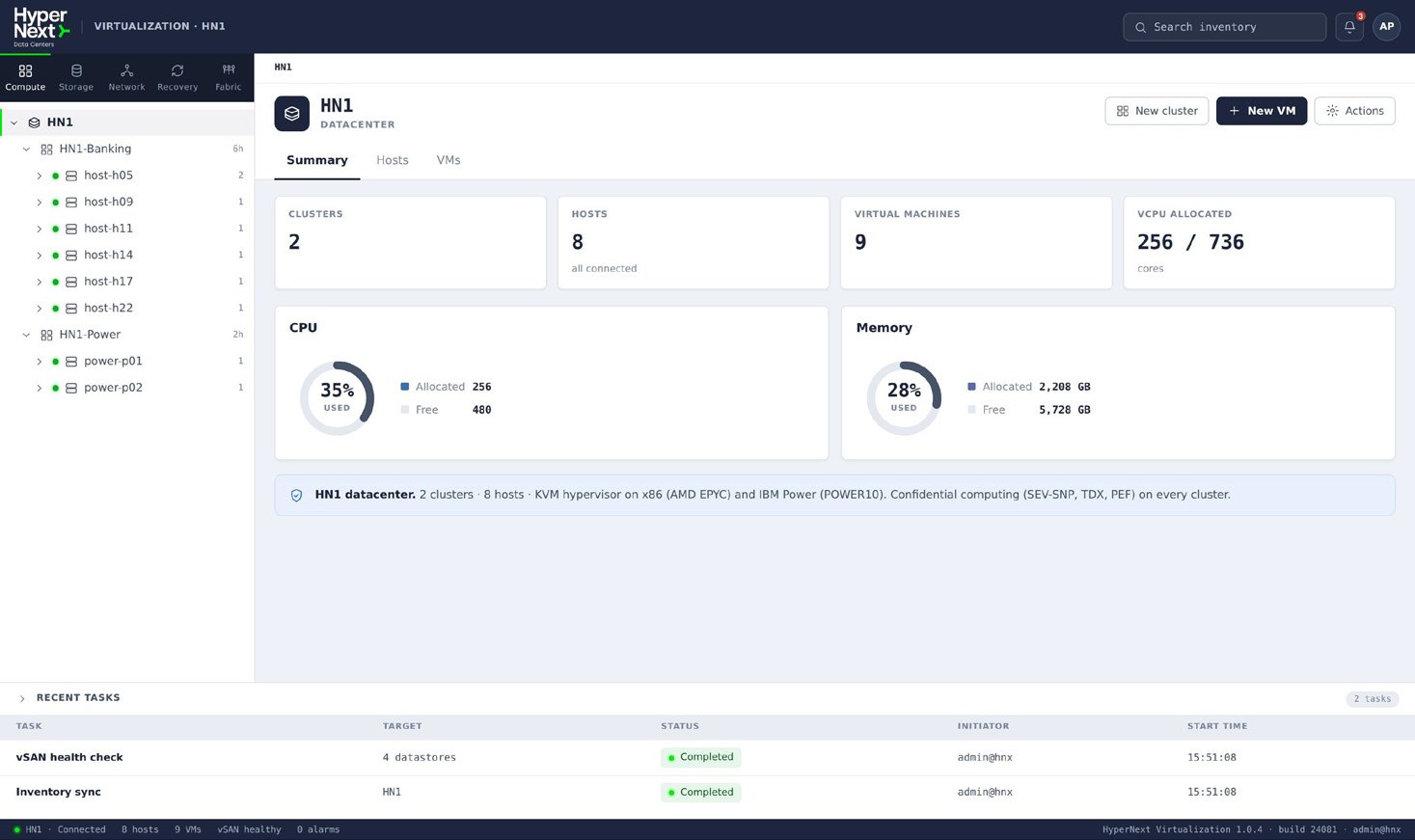
The Hyper 7 datacenter summary · clusters, hosts, virtual machines and confidential computing across every cluster

The Hyper 7 datacenter summary · clusters, hosts, virtual machines and confidential computing across every cluster

Explore Hyper 7 & the Evidence Layer →

HyperNext Scrub

The defensive loop
runs faster.

One design principle underneath all of it: the defensive loop must run faster than the offensive loop, and must keep running when no operator is watching. The median volumetric flood lasts between thirty-five and forty-five seconds, so a defence that waits for an analyst has already lost. Every packet is inspected inside India.
Mechanism 01
Dual-algorithm filtering
A deterministic stage handles the volumetric majority. An adaptive learning stage adjudicates the low-and-slow minority. Neither alone is sufficient.
Mechanism 02
Autonomous mitigation
Detection to clean return under sixty seconds, with the operator able to take manual control at any point rather than required to.
Mechanism 03
Attack absorption
Owned edge capacity carries the everyday band. Burst capacity handles the multi-terabit tail, and anycast splits an attack before filtering begins.
Mechanism 04
Line-rate enforcement
A packet-level datapath drops malicious traffic at the scrubbing core and re-injects clean traffic to origin, measured in packets, not only bits.
On public record
60s
detection to clean return, without a human
31.4Tbps
largest attack on record, Nov 2025
99%
of attacks remain under 1 Gbps
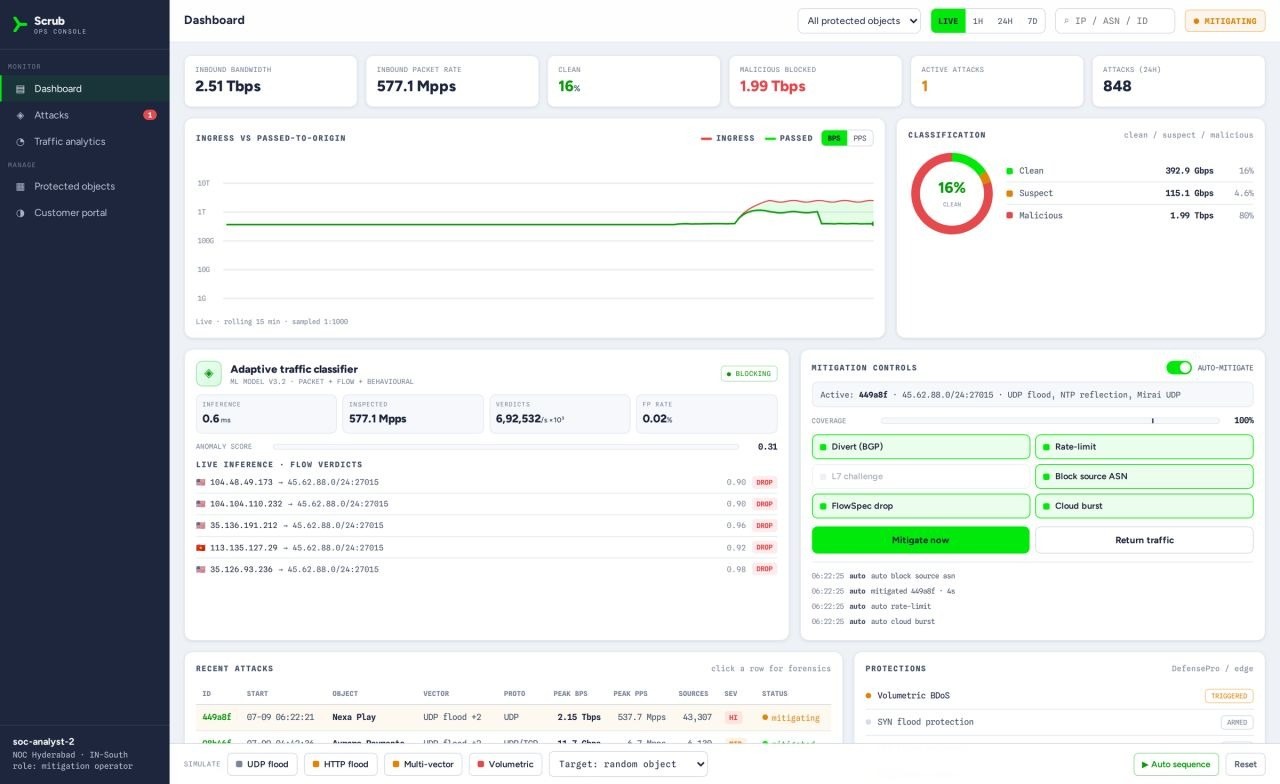
The Scrub operations console · live mitigation, adaptive classifier and per-flow verdicts

The Scrub operations console · live mitigation, adaptive classifier and per-flow verdicts

Cloud WAN & Drop

Every site, every cloud,
one fabric.

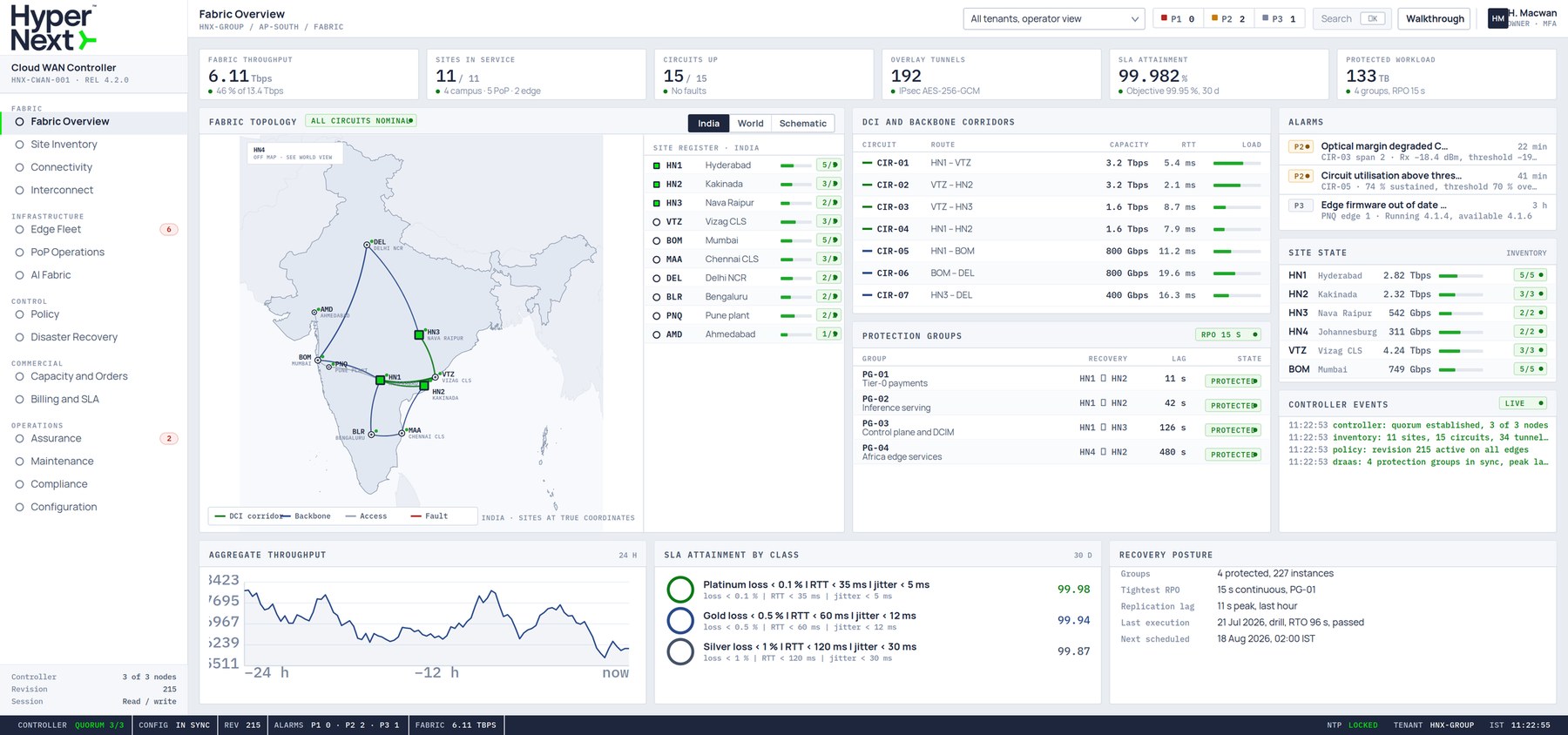
A software-defined wide-area network that connects your campuses, edges and cloud on-ramps as one tenant-scoped fabric, with Drop delivering disaster recovery as a service across it. Configuration, multi-site connect and recovery in a single console.
Multi-site connect
One logical fabric
Bring campuses, edge points of presence and cloud on-ramps into one tenant-scoped fabric, provisioned from a single console.
Drop
Disaster recovery as a service
Drop rides the same fabric, with orchestrated, testable failover between sites rather than a plan that has never been run.
Cloud on-ramps
Private interconnect
Direct, private interconnect to the major clouds, quoted and ordered in the console, not over email.
Edge and PoP
Managed, not just listed
Dedicated management and observability for every edge and point of presence, with their own controls, not inventory rows.
Commercial surface
Built in
Quoting, orders, billing on the 95th percentile, SLA credits and maintenance-impact analysis, all in the platform.
Compliance evidence
Carried on every link
Every interconnect carries the residency and audit evidence the sovereign platform is built on.
Built in
95th
percentile, usage-based billing
Anymetro
global site catalogue, exact coordinates
WrittenSLA
credits, automatic
The HyperNext Cloud WAN Controller showing fabric topology across India at true coordinates, DCI and backbone corridors, protection groups and SLA attainment by class

The Cloud WAN Controller · fabric topology, DCI and backbone corridors, and protection groups, live across India

BMS & Digital Twin

It reads the fluid as
it flows past.

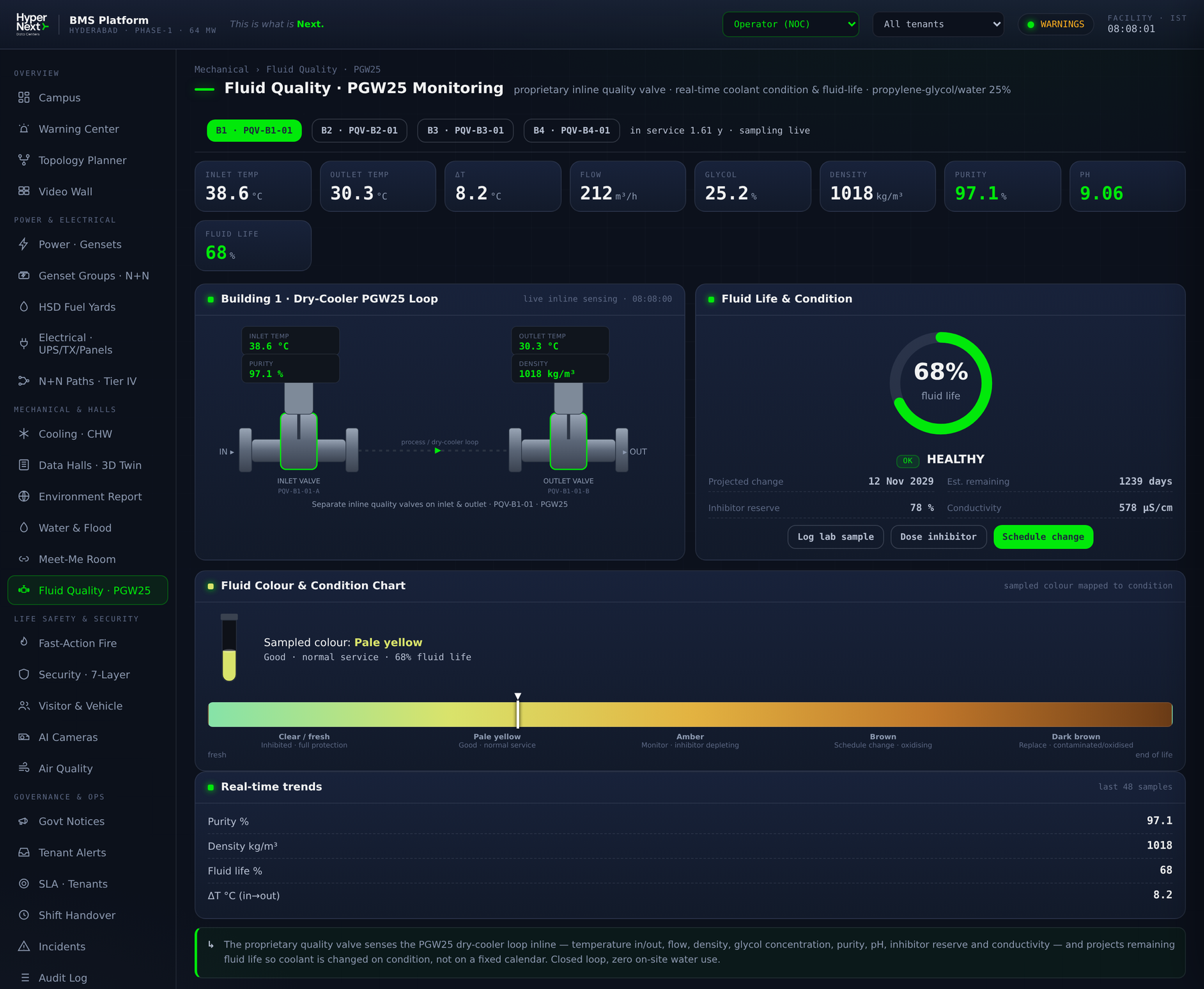
The building management system is ours, written in-house and wired to the plant. Coolant is changed on condition, not on a calendar, because an inline valve reads it as it flows and projects the life it has left. A rack-level digital twin runs alongside the physical campus, and every availability commitment is watched live and backed by service credits.
Reads fluid as it flows
No sample bottles
Temperature in and out, delta T, flow, density, glycol concentration, purity, pH, inhibitor reserve and conductivity, all read live as the coolant moves. No sample bottles and no trip to a lab.
Changed on condition
Not on a calendar
An inline valve reads the coolant as it flows past and works out how many days of life it has left. Two valves per loop, on the inlet and the outlet, wired straight into the BMS we wrote.
Sealed, dry cooling
Zero on-site cooling water
Sealed propylene-glycol loops and dry coolers, with no evaporative stage anywhere in the design, so the water a data centre uses to cool itself is effectively zero.
Predictive, not reactive
Before it becomes downtime
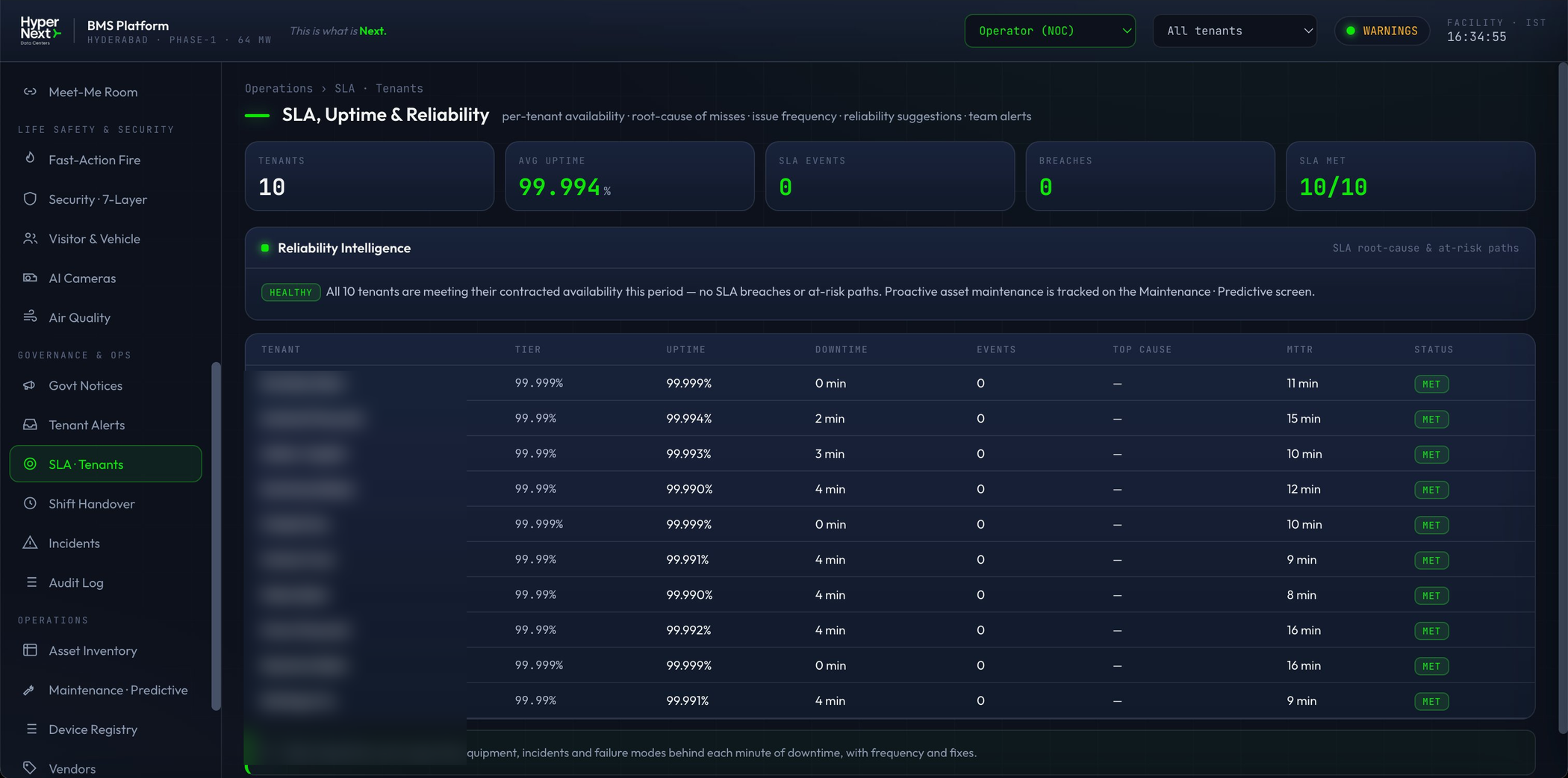
Asset health and root-cause analytics flag risk before it becomes downtime, watched around the clock per tenant from our own NOC.
3D digital twin
Rack-level
A rack-level digital twin runs alongside the physical data centre, for what-if and SLA simulation.
A credit-backed SLA
Held to it
Miss an SLA target and service credits apply automatically. The commitment carries financial weight rather than sitting in a contract as a sentence.
Live on the BMS
1,200+
days projected coolant life
0
on-site cooling water consumption
1.30
design PUE average, band 1.25 to 1.35
Building 1, PGW25 loop · live sensing, fluid-life projection, sampled colour mapped to condition
Building 1, PGW25 loop · live sensing, fluid-life projection, sampled colour mapped to condition

Per-tenant uptime and root-cause analytics on the HyperNext BMS, watched live from our own NOC

Per-tenant uptime and root-cause analytics on the HyperNext BMS, watched live from our own NOC

Assurance

Engineered to
the benchmarks.

Every layer is built to be checked. We publish the engineering behind each of these, and certification audits are scheduled against each facility's commissioning timeline. Uptime Institute Tier III and Tier IV. ISO/IEC 27001, 27017 and 27018. SOC 1 and SOC 2 Type II. RBI, SEBI and IRDAI for BFSI; CERT-In and NCIIPC for government and defence. Write to governance@hypernxt.com for signed policies, or ask for the paper behind whichever claim you would like to test.